
About Sketches
The world is such an incredibly fascinating place — and we live in such fortunate times to have photography to help us explore it. For decades, I've used photography as my excuse to travel, to meet people, to spend time in the most fascinating places, and to observe my little corner of the world. My earliest influences — great photographers of the West Coast tradition — all created their photographs following the methods that had been codified by Alfred Stieglitz: photography was something that was framed and hung on the wall to be seen as a visual artifact, like a painting in a gallery. The problem for me was that this was not the kind of photography I was interested in doing, but the only kind of "art photography" I knew. |
Sketches
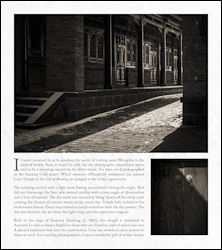 Sketches came about because of the simplest of questions: What is my artwork? That is to say, what is the most fundamental form of my work. When I was casually asked this question at a social gathering, my initial thought was images and ideas — interestingly, not photography — in particular, not prints. As I thought more about this over the following weeks, what then, I mused, is the best medium for images and ideas? If I answer prints — as I have for some 40 years — then book publications, PDFs, etc. are a supplemental format. Certainly this is how Adams, Weston, and all of their generation felt.
But are prints hung on the wall the best medium for images and ideas? What if I answer publications rather than prints? My head began to spin. Years of training protested — Art goes in the gallery or the museum! Yes, I thought, except when it lives in the concert hall, or the theater, or the novel, or the stage, or in people's homes, or when recorded for television, movies, or recorded music. So, maybe only a very limited type of art lives in the gallery or the museum. I started considering seriously a new form for my photography and text, my images and ideas.
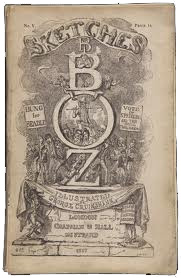 Inspired by the classic book Sketches by Boz (an early pen name of Charles Dickens, one of my favorite authors), I learned that every story need not be a tale with beginning, middle, and end — nor a morality play with a "message." Just looking and seeing the world for the fascinating thing that it is can be enough. Photography was built for just such a purpose. Combined with words, a photograph can be a sketch of life just as Dickens did with his words and the accompanying drawings by Cruikshank. Why not adapt Dickens' great idea for our modern tools?
In reviewing my photographic archives, I realized that I have thousands of small observations, moments, encounters, and experiences that are scattered throughout my photographic archive, just waiting for an ideal medium. Some are moments of wonderful light, some are portraits of interesting people, some breathtaking landscapes that inspired thought, some are simple small encounters that I hope are worth sharing. Eclectic in nature, varied in style and content, long and short, a few images or a dozen, lengthy text or just a sentence or two, I have been working in this format for decades, unaware that I was.
At long last brought to consciousness, the remaining question was one of finishing media. Because different audiences have different needs, I'm creating Sketches in two parallel media.
Chapbooks
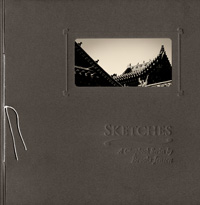 I love prints! I love the hand-held experience of viewing prints up close, the intimacy that comes from touching the paper. Well, is it possible to create an art form that is part book and part photographic print?
For years, my answer to this question has been as the folio — a new format I pioneered and shared with thousands of photographers though my workshops, podcasts, and through LensWork. I love the folio format, but it isn't a great match for every project. I needed something else, particularly where the order of pages is critical, e.g. when there is longer-form text involved.
Enter the hand-sewn chapbook. Derived from the "chapmen" of early England, chapbooks were originally small, pamphlet-like publications with religious tracts, political commentary, or even educational essays. In more modern times, the chapbook concept has been adopted by the art community as — typically — small, handmade book of poetry, calligraphy, or occasionally a short story. Artist-made chapbooks are a celebration of paper and handcraft. Chapbooks are the perfect vehicle for images and text to combine in an artifact that preserves the beauty of a photographic print with the design elements of layout and text. They can be a few pages in length to a dozen or more.
Chapbooks are an ideal format and medium for photographs, particularly now that we photographers can produce our work on printed pages using pigment-on-paper printers. They are part book, part original print, part layout and text, part handcraft. What a wonderful way for Sketches to manifest in tactile materials! I print on Moab Entrada Natural White 190, a two-sided paper, using Epson K3 inks on my Epson 4880 printers. Each chapbook is numbered and signed by me.
ePublications
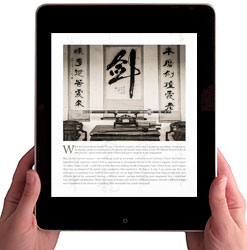 The chapbooks are great, but I know that not everyone values the printed page as much as others do. In today's fast-paced technological world, the world-wide delivery of digital content is too important to ignore. As an artist, I've watched the iPad and other tablets quickly becoming a mainstay vehicle for viewing photography, books, and all kinds of ePublications. We know this because we publish LensWork Extended and have seen it grow from a curiosity to a world-wide phenomenon.
With this in mind, Sketches are being published as free, downloadable PDFs which allow me to present the content of the chapbook edition to a worldwide audience as well as to an audience for whom purchasing a physical product is not possible. Because these are digial publications, I'm not bound by the restrictions of physical pages. With some titles, I'll add additional images or even audio or video content.
The ePublication PDF editions of Sketches allow anyone in the world access, all for free and all in the spirit of sharing. They can also be viewed on any computer using the Adobe Reader or other PDF viewer application.
Most importantly, they are designed for iPad and Android tablets using any standard PDF reader. (We recommend GoodReader for the iPad, and either the Kindle Reader or Mantano Reader for Android tablets.)
Pricing and Non-Pricing
So much of "art-marketing" is based on hyperbole — and even downright hidden agendas and subterfuge. I've always traveled a different path — both with my personal work, and with LensWork. I've always felt it was better to be up front, candid, do the highest quality work I can, and let the chips fall where they may. Here are my thoughts about this new Sketches project.
- Audience: As an artist, I could just do my work and store it away in the closet. Many artists do. I've always thought art is best used as a means to bring people together, to connect ideas and audience, to bridge the gaps between us all. To me, art without an audience is a tragedy.
- Dynamic: Life is movement, energy, vitality. Art need not be a dusty thing in museums. In fact, it's better if it is alive and growing. I don't want Sketches to become a pile of aging artifacts of what I did last year, on sale in perpetuity. The intent is to create a program that moves with time and dances with the creative life.
- Incentive: I am a photographer and artist — terms that I've always thought should be verbs. My incentive with this program is to provide a vehicle that encourages work and that motivates me to produce; encourages you to look, and to come back regularly to see what's new.
- Abundance: As we all know, beauty is in the eye of the beholder. You may love one project and not another. Everyone else will, too — just different ones. This Sketches program is design for breadth of titles rather than depth of inventory.
- Innovation: I am much more interested in the images and ideas than in spending hours and hours in the labor of repetitive production. Therefore, I've structured Sketches to provide incentive to new titles rather than long production runs of old titles.
- Accessible: Art should be affordable with as little financial barrier as possible. The chapbooks are priced accordingly; the PDFs are free.
- Support: Making art requires money. I offer my artwork for sale not so I can become wealthy (although I wouldn't complain about it), but rather so I can fund the next project and keep working.
With all this in mind, I'm offering the Sketches in two media, designed for two different audiences.
Chapbooks |
|
Chapbooks are available individually, but my hope is that you'll want to collect them — the more the better! So, there is an escalating discount available for the purchase of more than one at a time. |
You have incentive to save and I get to see my work sent out into the world where it can live! |
PDF ePublications |
|
A PDF version of each Sketches title will be published at the same time the paper chapbook is announced. Sometimes, these will be expanded versions with additional images that are not represented in the chapbooks. PDF versions of Sketches will always be available for download; there is no termination date. These are free ePublications. |
You can view the work on your iPad or other tablet, as well as on your PC or Mac computer. These are regular PDF files that can be viewed using any PDF reader. What's in it for me? PDF publishing offers me the ability and incentive to produce work that is accessible to anyone worldwide. |
The price for my chapbooks is $35 each, but are as little as $23 if you buy 4 or more at a time. Why $35? Cost of paper and ink plus the cost of labor and time for my assistant and myself to do the production work. What other handmade, original artwork can you buy for about the same price as a nice meal in a restaurant, a commercially published art book, a movie date, or half a concert ticket? Essentially, I guess it just seems like a fair price. (If you think this is too much I can only imagine your reactions to the prices in photo galleries!) Besides, just buy in multiples and you'll never pay $35.) And if you think $35 is too little, then I can assume you will be collecting them with regularity. :-)
Brooks Jensen
August 2013